
Retirement Visa for Vietnam: What Options Exist?
Latest update: Oct 14th, 2026
Table of Contents
Many foreigners are attracted to Vietnam for a slower lifestyle, warm climate and longer stays after leaving full-time work. However, Retirement Visa for Vietnam is not currently an official visa category granted simply because an applicant has reached retirement age. Instead, retirees need to identify another lawful entry or residence option that fits their circumstances. Expedite Vietnam Visa helps travelers understand available visa routes, organize application information and choose an option that better matches the intended length and purpose of stay.
Does Vietnam currently offer a retirement visa?
No. Vietnam’s immigration framework does not currently list a separate visa symbol specifically for foreign retirees. Reaching retirement age, receiving a pension or proving retirement income does not by itself create a dedicated retirement visa category.
Why is “retirement visa” still widely searched?
The term is commonly used because several countries offer residence schemes specifically for retirees. Travelers therefore assume Vietnam has a similar program.
Vietnam instead classifies visas and residence permissions according to recognized purposes and qualifying circumstances. Recent immigration changes added new UĐ1 and UĐ2 preferential visa categories, but no general retirement visa category was introduced.
Can retirees still spend extended time in Vietnam?
Yes, but the immigration basis matters. A retiree may enter Vietnam using an e-Visa for an eligible temporary stay or may qualify for another visa or residence status through investment, family relationship or another recognized basis.
For comparison, nationality also affects short-term entry planning. The Vietnam Visa for Mongolians guide illustrates how some travelers may have a visa-exemption option that changes their initial entry strategy.
Does pension income create visa eligibility?
Not by itself. Vietnam does not currently operate a general retirement scheme where applicants qualify simply by demonstrating a certain age, pension or monthly retirement income.
That means travelers should be cautious with information describing fixed “Vietnam retirement visa income requirements” as though they were part of an official standalone program.
What options can foreign retirees consider instead?
The practical question is not “How do I apply for a retirement visa?” but “Which legal entry or residence route actually fits my situation?” Different retirees may have very different options depending on nationality, family ties, investments and desired length of stay.
Can an e-Visa work for a temporary retirement stay?
Yes. Vietnam’s e-Visa can be valid for up to 90 days, with either single or multiple entry. It can therefore suit retirees who want to spend a limited period in Vietnam without immediately pursuing a longer-term residence arrangement.
Travelers should still check nationality-specific entry conditions. The Vietnam Visa for Ugandans page is an example of how passport type and visa requirements can affect the initial travel plan.
Can family relationships support longer residence?
Potentially. Foreign spouses and certain family members of Vietnamese citizens can qualify for family-related immigration options when the legal relationship and other conditions are satisfied.
The Ministry of Public Security confirms that Vietnamese citizens can sponsor certain foreign family members for visa or temporary-residence procedures when documentary proof of the relationship is provided.
This route depends on the family relationship, not retirement status.
Can investment create a longer-term option?
Foreign investors can have immigration options linked to qualifying investment activities. Investor visa and temporary residence provisions are separate from retirement status and require an actual legal investment basis.
A retiree should therefore not treat “investor residence” as a retirement visa unless they genuinely meet the investment requirements applicable to their case.
Travelers researching broader nationality-based Vietnam entry rules may also compare the Vietnam Visa for Tanzanians guide.
How should retirees compare the available routes?
The useful comparison is based on why the person qualifies to stay, not simply on age. A retiree with no family or investment connection may have a very different pathway from someone married to a Vietnamese citizen or participating in a qualifying investment.
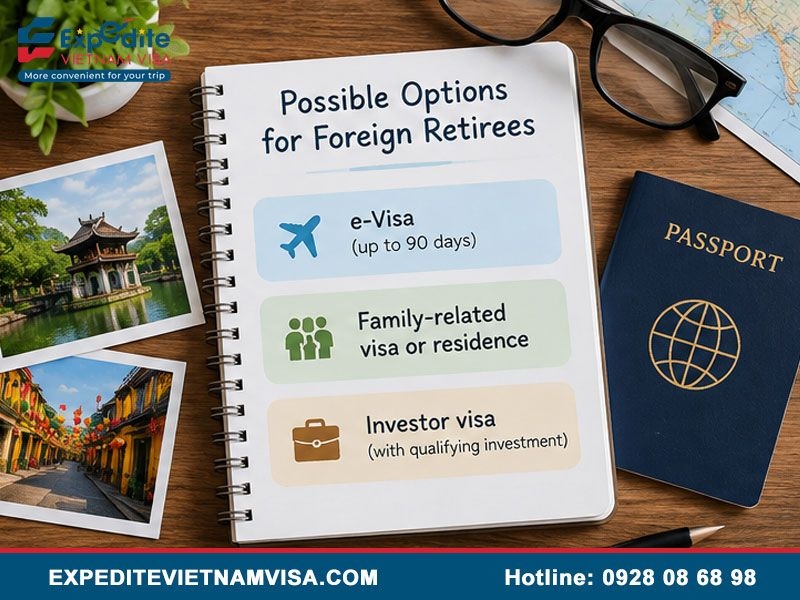
Which route fits which situation?
Traveler situation | Possible route to examine | Main limitation |
|---|---|---|
Short seasonal stay | Vietnam e-Visa | Maximum validity up to 90 days |
Several entries during one trip | Multiple-entry e-Visa | Valid only within approved visa period |
Spouse/family connection in Vietnam | Family-related visa or residence option | Requires qualifying relationship |
Genuine investment activity | Investor-related visa/residence route | Requires qualifying legal investment |
Retirement only, with pension income | No dedicated retirement category | Age or pension alone does not create eligibility |
This distinction is important because there is no separate government application called “Vietnam Retirement Visa” with its own age threshold and pension checklist.
How much should retirees budget for visa costs?
There is no official “retirement visa fee” because Vietnam does not currently issue a standalone retirement visa.
For travelers using the e-Visa route, the government fee is:
Entry option | Government fee |
|---|---|
Single-entry e-Visa | USD 25 |
Multiple-entry e-Visa | USD 50 |
The national e-Visa portal states these fees and notes that the application charge is non-refundable if the visa is not granted.
Expedite Vietnam Visa service charges are separate and can depend on the type of assistance requested. Travelers can provide their intended stay, nationality and travel schedule to receive a service quote suited to the case.
Why does nationality still matter?
Even when two people have the same retirement plans, their initial entry conditions may differ because visa exemptions and passport rules are nationality-specific.
For example, a traveler researching Southeast Asian retirement travel may compare the Vietnam Visa for Maldivians, while a European traveler may need to assess the rules covered in Visa to Vietnam for Latvian Citizens.
The retirement goal may be similar, but the starting immigration position is not always the same.
What should retirees plan before moving to Vietnam?
A long stay should be planned around legal immigration status rather than assuming a tourist entry can function indefinitely as a retirement residence solution. The suitable route depends on both current eligibility and future plans.
How long does the traveler actually want to stay?
Someone spending two or three months in Vietnam may find an e-Visa sufficient. Someone intending to base themselves in Vietnam for years needs to examine whether they qualify for a residence status supported by family, investment or another lawful basis.
The Vietnam Visa for Tunisians article is another useful example of why short-term visa eligibility should be separated from long-term residence planning.
Should retirees rely on repeated short-term visas?
Repeated short visits and genuine long-term residence are not the same immigration strategy. A person intending to live primarily in Vietnam should evaluate whether they qualify for an appropriate longer-term status rather than assuming short-term entry options can always be repeated indefinitely.
Vietnam’s current system ties residence permissions to qualifying legal circumstances rather than a general retiree category.
What should be checked before making long-term commitments?
Before signing a long lease, moving possessions or restructuring personal finances around a Vietnam retirement plan, confirm:
Which immigration route actually applies.
How long the status allows you to remain.
Whether multiple entry is permitted.
Whether sponsorship or supporting documents are required.
What happens when the visa or residence period expires.
This helps separate lifestyle planning from assumptions about immigration eligibility.
Questions People Ask About Retiring in Vietnam
The term “retirement visa” can create confusion because online discussions sometimes describe long-stay strategies as though they were an official visa category.
Is there an age requirement for a Vietnam retirement visa?
No official minimum retirement age applies because Vietnam does not currently have a dedicated retirement visa category. Age alone does not create a specific immigration route.
Can foreigners live permanently in Vietnam just because they are retired?
No. Retirement by itself does not provide permanent residence eligibility. Long-term or permanent residence depends on specific legal conditions under Vietnam’s immigration framework rather than simply being retired.
Can a retiree use a Vietnam e-Visa?
Yes, if the traveler meets the e-Visa conditions. An e-Visa can be valid for up to 90 days and may allow single or multiple entry, making it useful for temporary stays rather than permanent retirement residence.
Build a Vietnam Stay Around a Valid Visa Route
Retiring in Vietnam starts with understanding what immigration status actually supports the intended stay. Instead of searching for a retirement visa that is not currently a separate category, travelers can compare temporary e-Visa stays with any family, investment or residence options they genuinely qualify for.
Expedite Vietnam Visa can help organize the relevant visa information, review the planned stay and identify an appropriate application route, allowing retirees to plan their time in Vietnam from a clearer legal starting point.
Contact Expedite Vietnam Visa
Email: [email protected]
US phone: +1 (972) 666-0676
Vietnam phone: +84 928 08 68 98
WhatsApp: +84 928 08 68 98
Website: https://expeditevietnamvisa.com/
Head Office:
1900 Jay Ell Drive, Richardson, TX 75081, United States
Branch Office:
4000 North O Street, Fort Smith, AR 72904, United States
Representative Office:
56 Nguyen Cu Trinh Street, District 1, Ho Chi Minh City, Vietnam
- Categories:
- Blogs

Over the past 23 years in the travel service industry, the growth and success of TRANSOCEAN have stemmed not only from the dedication of our well-trained, enthusiastic, and customer-oriented staff, but also from the exceptional leadership of our Founder and CEO, Mr. STANLEY HO. With more than 20 years of experience in the travel and tourism sector, Mr. STANLEY HO possesses profound knowledge of the market, customer behavior, and modern travel trends. His strategic vision has guided the company toward sustainable growth while maintaining a strong commitment to service quality.