
Loading time...

Vietnam Working E-Visa: Requirements, Work Permit and Application Guide

Apply Working E-visa to Vietnam

Foreign professionals entering Vietnam for business projects, employment preparation or other work-related activities may consider a Vietnam Working E-visa as an entry option. Vietnam’s electronic visa can be valid for up to 90 days and may allow either single or multiple entry.

The government fee is US$25 for a single-entry e-Visa and US$50 for a multiple-entry e-Visa. However, an e-Visa mainly provides permission to enter and stay in Vietnam. Foreigners taking up formal employment may also need a Work Permit or a recognized Work Permit exemption.

Expedite Vietnam Visa helps applicants review their visa information, prepare application details and choose a suitable processing option before travelling.

What Is a Vietnam Working E-Visa?

A Vietnam Working E-visa generally refers to a Vietnam e-Visa used by a foreign professional travelling for work-related purposes. It is not a separate legal category that automatically gives the holder permission to work.

Vietnam’s e-Visa can currently be issued for up to 90 days.

E-Visa Feature

Information

Maximum validity

Up to 90 days

Entry type

Single or multiple

Single-entry fee

US$25

Multiple-entry fee

US$50

Application

Online

The e-Visa may be suitable for professionals attending meetings, visiting business partners, joining project discussions or preparing for a longer employment assignment.

Does a Vietnam Working E-Visa Allow You to Work Legally?

An e-Visa alone should not automatically be treated as legal authorization for employment in Vietnam.

The visa and Work Permit systems serve different purposes:

  • An e-Visa allows entry and temporary stay.

  • A Work Permit authorizes eligible foreign employment.

  • A Work Permit exemption may apply to certain qualifying foreigners.

  • An LĐ1 or LĐ2 visa may be relevant for longer employment arrangements.

This means a foreign national can legally enter Vietnam on an e-Visa but may still need additional work authorization before starting formal employment.

vietnam-working-e-visa-1.jpg

Who Can Use a Vietnam E-Visa for Work-Related Travel?

A Vietnam e-Visa may be appropriate for professionals entering the country temporarily for commercial or work-related activities.

Examples may include:

  • Attending business meetings

  • Meeting a prospective employer

  • Participating in negotiations

  • Visiting suppliers

  • Attending conferences

  • Joining project discussions

  • Visiting a workplace before a longer assignment

The correct visa route depends on what the foreigner will actually do in Vietnam.

For travellers coming mainly for meetings, negotiations or other commercial activities, the Vietnam Business Visa may also be relevant.

What Is the Difference Between an E-Visa and a Work Permit?

An e-Visa and a Work Permit are different documents with different legal functions.

Document

Main Purpose

Vietnam e-Visa

Entry and temporary stay

Work Permit

Permission for eligible foreign employment

Work Permit exemption

Recognized exemption from standard Work Permit rules

LĐ1 Visa

Work-related visa for certain exempt workers

LĐ2 Visa

Work-related visa for workers requiring a Work Permit

Temporary Residence Card

Longer-term residence for eligible foreigners

A short business visitor may only need an appropriate entry visa. A foreigner entering into formal employment may need both immigration status and employment authorization.

Do Foreign Workers Need a Work Permit in Vietnam?

Many foreign workers need a Work Permit, although exemptions are available in specific cases.

A Work Permit may be relevant to foreigners working under arrangements such as:

  • Employment contracts

  • Intra-company transfers

  • Service contracts

  • Project assignments

  • Management positions

  • Expert roles

  • Technical positions

The fact that an e-Visa is valid for up to 90 days does not automatically mean that a Work Permit is unnecessary.

The foreign worker and Vietnamese employer should determine the correct employment status before work begins.

Who May Qualify for a Work Permit Exemption?

Certain foreign nationals may qualify for an exemption from the standard Work Permit requirement.

Depending on the circumstances, exemption categories may include some:

  • Intra-corporate transferees

  • Company owners

  • Capital-contributing members

  • Board members

  • Short-term professional workers

  • Service providers

  • Foreigners covered by international agreements

An exemption should not be assumed simply because an assignment is short.

The Vietnamese employer or sponsoring organization should confirm whether the worker meets the required conditions.

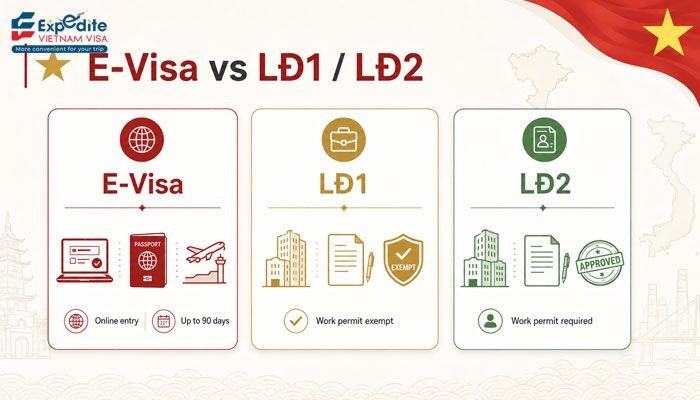
What Is the Difference Between a Vietnam Working E-Visa and LĐ1 or LĐ2?

A Vietnam e-Visa is mainly designed for temporary entry, while LĐ1 and LĐ2 are more directly connected to employment status.

What Is an LĐ1 Visa?

LĐ1 generally applies to foreign workers who qualify for a Work Permit exemption.

The worker must have a valid legal basis for that exemption.

What Is an LĐ2 Visa?

LĐ2 generally applies to foreign workers who are required to hold a Work Permit.

This visa is more relevant to people entering Vietnam for formal or longer-term employment.

Foreign professionals should therefore choose their visa route based on their actual work arrangement rather than only on processing convenience.

Does a Vietnamese Company Need to Sponsor the Worker?

Foreigners can generally apply for an e-Visa independently, but formal employment normally requires support from a Vietnamese employer or qualifying organization.

The company may need to:

  • Confirm the employment position

  • Provide company documents

  • Support the Work Permit process

  • Confirm whether an exemption applies

  • Support an LĐ visa application

  • Assist with residence documentation

This is one of the main differences between applying for a basic e-Visa and preparing for long-term employment in Vietnam.

What Documents Are Needed for a Vietnam Working E-Visa?

The e-Visa application normally requires basic passport and travel information.

Applicants should prepare:

  • Valid passport

  • Digital passport data-page image

  • Clear portrait photo

  • Entry date

  • Departure date

  • Entry and exit checkpoint

  • Accommodation information where required

  • Contact and travel information

Applicants should make sure that the passport number, full name, nationality and dates are entered correctly.

If a Work Permit is also required, additional documents may include:

  • Employment documents

  • Employer information

  • Professional qualifications

  • Evidence of work experience

  • Health documents

  • Criminal record documents

  • Work Permit exemption evidence where applicable

How Do You Apply for a Vietnam Working E-Visa?

The application is completed online.

Step 1: Confirm Your Travel Purpose

Determine whether the trip involves temporary business activities or formal employment.

This helps establish whether an e-Visa alone addresses the immigration requirement.

Step 2: Prepare Your Documents

Prepare your passport copy, portrait photo and travel information.

Make sure all details match the passport.

Step 3: Complete the Online Application

Enter the required personal and travel information carefully.

Pay particular attention to:

  • Full name

  • Passport number

  • Nationality

  • Entry date

  • Entry checkpoint

Step 4: Pay the E-Visa Fee

The current government fee is:

  • US$25 for single entry

  • US$50 for multiple entry

The fee is generally non-refundable.

Step 5: Check and Download the Result

Use the application registration information to check the result.

Once approved, download the e-Visa and check all information before travel.

Step 6: Complete Work Authorization if Required

If you will begin employment in Vietnam, coordinate with the employer to complete any required Work Permit or exemption procedure.
vietnam-working-e-visa-2.jpg

How Long Is a Vietnam Working E-Visa Valid?

A Vietnam e-Visa can be valid for up to 90 days.

It may allow either:

  • Single entry, or
  • Multiple entry.

Applicants should check the exact validity period shown on the approved visa.

A 90-day e-Visa should not be considered a replacement for a longer-term employment immigration solution.

Workers remaining in Vietnam for an extended period may need to move to the appropriate work-related visa or residence status.

How Long Does Vietnam Working E-Visa Processing Take?

Standard e-Visa processing is generally completed within several working days, but applicants should avoid applying immediately before departure.

Processing may be affected by:

  • Weekends
  • Public holidays
  • Incorrect application details
  • Poor passport images
  • Incorrect photos
  • Requests for corrections

Applicants should also remember that Work Permit processing follows a separate timeline.

The Vietnam Visa Processing Time page can help travellers understand available processing options for their visa application.

Can You Enter Vietnam Before Your Work Permit Is Ready?

A foreigner may be able to enter Vietnam on a valid e-Visa before a Work Permit is completed, depending on the circumstances.

However, entry permission and work authorization are separate.

Before beginning employment, the foreign worker should confirm:

  1. Whether a Work Permit is required.
  2. Whether an exemption applies.
  3. Whether employer documents are complete.
  4. Whether an LĐ visa is required later.

Holding an e-Visa does not automatically mean the holder may begin formal employment.

What Common Mistakes Should Applicants Avoid?

Many problems arise because applicants treat the e-Visa and Work Permit as the same thing.

Common mistakes include:

  • Assuming an e-Visa automatically allows employment
  • Ignoring Work Permit requirements
  • Assuming all short-term work is exempt
  • Entering incorrect passport information
  • Uploading unclear images
  • Choosing the wrong entry type
  • Applying too close to departure
  • Failing to coordinate with the employer

Checking the visa route and employment requirements early can reduce delays and unnecessary corrections.

How Can Expedite Vietnam Visa Support Working E-Visa Applicants?

Expedite Vietnam Visa helps foreign professionals prepare their Vietnam visa applications with greater clarity and fewer avoidable errors.

Support may include:

  • Reviewing passport information
  • Checking application details
  • Reviewing passport and portrait images
  • Identifying common form errors
  • Helping applicants select a suitable processing option
  • Supporting application-status tracking
  • Explaining the difference between short-term e-Visa entry and longer-term work visa routes

This is particularly useful for professionals who already have a business assignment or employer in Vietnam but are unsure which visa option is suitable for their initial entry.

Applicants using the service can also access the Check Status page to monitor their application.

Frequently Asked Questions About Vietnam Working E-Visas

Is Vietnam Working E-Visa an official visa category?

The term is commonly used for a Vietnam e-Visa used in connection with work-related travel. It should not be confused with a Work Permit or the LĐ1 and LĐ2 visa categories.

How long can a Vietnam e-Visa last?

A Vietnam e-Visa can currently be valid for up to 90 days with either single or multiple entry.

How much does a Vietnam e-Visa cost?

The government fee is US$25 for single entry and US$50 for multiple entry.

Can I work in Vietnam with only an e-Visa?

Not automatically. Depending on the type of work, a Work Permit or recognized exemption may also be required.

Do I need a Vietnamese employer to apply for an e-Visa?

An e-Visa can generally be applied for independently. Formal employment procedures, however, usually require participation from the Vietnamese employer.

Is an e-Visa the same as an LĐ2 visa?

No. An e-Visa is a temporary electronic entry visa, while LĐ2 is a work-related visa associated with foreigners who require a Work Permit.